Blog · 30 posts
Good data work is worth explaining.
Practical posts on analytics engineering, semantic layers, and AI agents built with trust in mind.
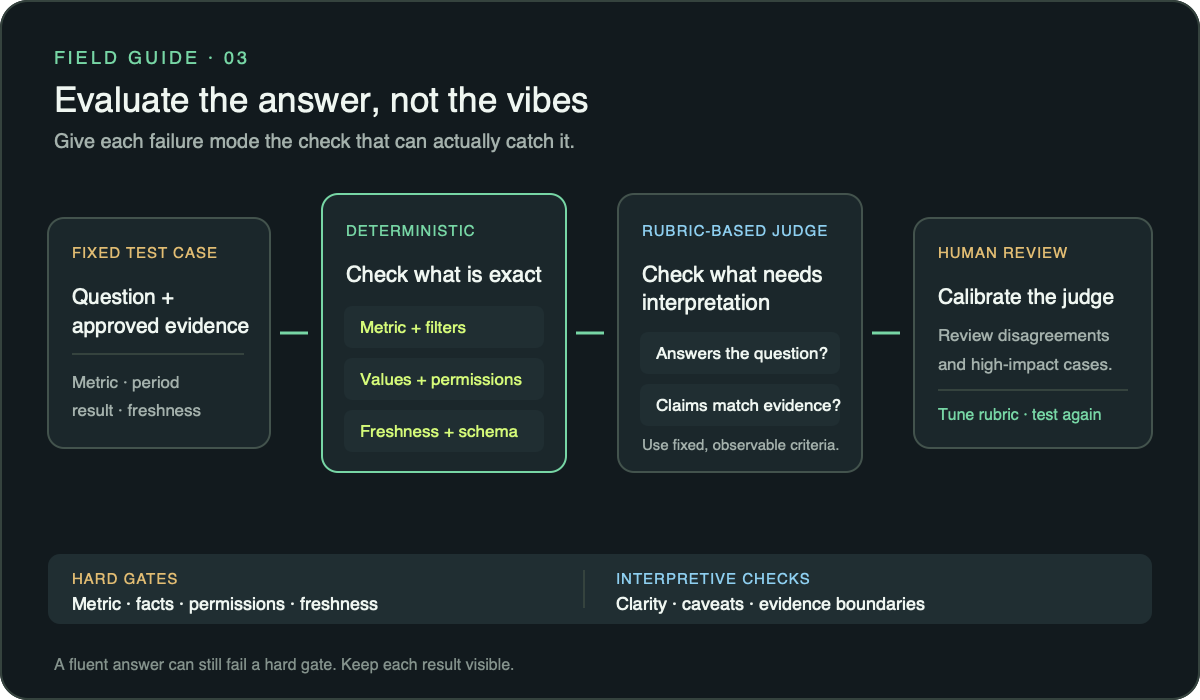
Can you trust this answer? Evaluate the whole analytics agent
Build useful analytics-agent evaluations with deterministic checks, calibrated LLM judges, human review, and cases that test the whole answer path.
The archive · newest first
Find your next useful idea.
Latest stays featured by default. Search and topics apply to the full archive.
Give your analytics agent the right context, not the whole warehouse
A practical way to assemble relevant, current context for analytics agents without dumping every metric, schema, and chat turn into the prompt.
Give your analytics agent a contract, not a bigger prompt
A clear, practical guide to defining metric meaning, grain, time, joins, and access before an AI agent queries business data.
Agents on your semantic layer, Part 2: Three additions that make it production-safe.
Add disambiguation pre-flight, template matching, and three-tier memory to your dbt Semantic Layer agent. Part 2 of 2 — the hardening layer.
Agents on your semantic layer, Part 1: Three tools. One loop. A working analytics agent.
Build a real analytics agent on dbt Semantic Layer and Snowflake: three tools, one Claude loop, about 80 lines of Python. Part 1 of 2.
Agents on your semantic layer, Part 0: Your analytics agent is confident. That's the problem.
Semantic layer agents fail silently. Here's what breaks, how to prevent hallucinations, and why your agent should ask before it answers.
40 data alerts at 6am. AI triaged them in 90 seconds.
Data monitoring tools produce more alerts than humans can triage. Here's the classification framework and prompt structure to separate signal from noise.
Six analytics jobs I've handed to AI — none of them are writing SQL
SQL generation demos well. Here's where AI actually saves the most time in analytics work — and none of it is writing code.
You've been flattening Snowflake JSON wrong
LATERAL FLATTEN is the wrong default for Snowflake JSON. Dot-notation, parsed columns, and when to actually flatten — with SQL for each.
How to know if your analytics agent still works: a deterministic eval harness
Scoring, cost tracking from real runs, and regression gating for a dbt analytics agent — without LLM-as-judge.
Building an analytics agent on a real dbt project: what actually broke
A build log for dbt-agentic-engine — four tools, a hard call budget, a structured trace, and the things that only broke on live API calls.
Revenue Intelligence Agent: an AI co-pilot that stops Customer Success from firefighting
A demo and build log for Revenue Intelligence Agent — an AI co-pilot that turns a renewal pipeline into daily, proactive CS action.
Reconciling competing metric definitions across teams with an LLM
An LLM can't decide what 'active customer' means. It can find every definition you have, show where they diverge, and draft the doc.
Forecasting with an LLM vs. a real time-series model: where each one is the right call
An LLM is good at explaining a forecast, not producing one. Where Prophet or ETS still beats asking Claude to predict next quarter's numbers.
Snowflake clustering keys: what they are, when they help, and when to skip them
Clustering keys improve query performance by rearranging micro-partitions — but they cost credits continuously. Here is when the trade-off is worth it.
Idempotency in dbt: the one pipeline property worth obsessing over
Most dbt models look idempotent but aren't. What breaks it silently and the concrete patterns — unique_key, surrogate keys, partition replacement — that fix it.
AI for analytics engineering: where it actually helps and where it doesn't
Not a hype piece. Where AI tools earn their place in an analytics engineering workflow — and where they consistently fall short.
dbt packages worth using in 2026
An honest assessment of which dbt packages actually earn their dependency weight — and which ones add complexity without proportional value.
Dimensional modeling in dbt: the patterns that don't fit the textbook
Kimball tells you what to build, dbt gives you the tools. Where SCD Type 2 snapshots, bridge tables, and role-playing dimensions actually live.
How to write dbt tests that catch real business logic errors (not just nulls)
Most dbt test suites catch infrastructure failures like nulls and duplicate keys, but miss the business logic errors that surface in weekly business reviews.
dbt Semantic Layer vs. homegrown metric marts: when to use which
A practical decision framework for analytics engineers choosing between pre-aggregated metric marts and the dbt Semantic Layer with MetricFlow.
Snowflake Cortex Analyst in practice: what the demo doesn't show you
Cortex Analyst looks smooth in a demo. Here is what actually happens when you point it at a real warehouse in week two.
AI-assisted SQL review: using Claude to catch data quality issues before they ship
Not 'AI is transforming data teams' — a concrete workflow: the prompt, what it catches reliably, and where it fails. For analytics engineers who review dbt PRs.
Late-arriving data: the silent failure that breaks your incremental models
Your dbt run succeeds. Tests pass. The dashboard looks fine. The data is still wrong. Late-arriving events and the dbt patterns that handle them correctly.
dbt incremental models: the complete guide
How incremental models work, when each strategy applies, and the patterns that only surface after something breaks in production.
How I set up Claude Code for analytics engineering work
Most analytics engineers re-explain their stack every AI session. CLAUDE.md, skills, and a few conventions make Claude useful from the first prompt.
Why governed AI on your warehouse beats RAG on your docs
Most enterprise data AI projects start by indexing documentation — here is why that is backwards, and what a warehouse-native approach looks like instead.
How to build a modern analytics data platform: the decisions nobody documents
Everyone writes about the tools. Nobody writes about the architectural choices made in the first three months that you cannot change without rebuilding.
From Excel to dbt: a realistic transition guide for Polish data teams
A practitioner's guide to migrating analytics from spreadsheets to dbt, covering the governance and trust-building steps that most teams skip.
Why your dbt project has 47 models and nobody trusts any of them
The dbt trust problem isn't a tooling issue — it's architectural. It shows up in every team that moved fast and skipped the governance layer.
No blog posts match. Try another topic or clear your search.
Category color marks the primary topic; filters also match secondary topics.